
Hours
- Mon-Sat: 10:00am-2:00pm
Tue-Thu: 17:00pm-20:30pm
Contact
-
(+30) 698 798 53 75
Contact Form
Endodontics (Aponeurosis)
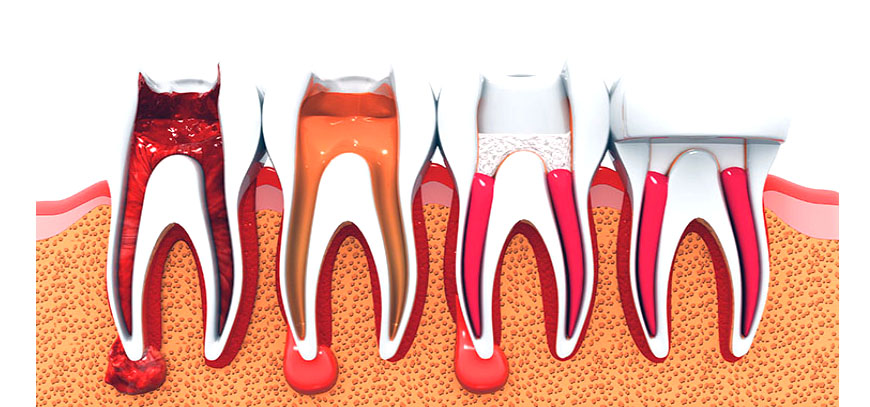
Endodontology is the specialty of Dentistry that deals with the diagnosis and treatment of diseases of the tooth pulp.
At the end of the root of a tooth there is a hole through which the blood vessels and nerves enter the inside of the tooth. From this hole a tube (root canal) starts inside which leads the vessels and nerves to a larger chamber (molar chamber) above the roots of the tooth. All the vessels and nerves of a tooth make up its pulp.
Due to the presence of nerves inside the tooth, the teeth have sensation, as a result, when they receive strong stimuli (eg cold, hot) this translates into pain of varying intensity, depending on the intensity of the stimulus .
In cases of tooth fractures or caries, where a part of the tooth’s protective outer shell has been destroyed, the nerve perceives stimuli more strongly. This can lead to inflammation of the nerve, resulting in severe pain (pulpitis). This pulpitis is not always reversible and can lead to nerve necrosis. Necrosis can also occur when the nerve is exposed to the environment either by a deeper fracture or when caries extends into the pulp of the tooth. Finally, intense occlusal forces exerted on the tooth can crush the nerve at the point of its entry into the tooth, again leading to its necrosis.
Although the dead nerve does not cause pain to various stimuli, yet necrosis and infection of the exposed nerve produces products of decay and inflammation. These usually exit through the opening at the end of the root, destroying the jawbone and creating a cyst. If this cyst expands, it can cause an abscess that leads to severe pain.
To deal with all these problems, endodontic treatment (denervation) is necessary.
How is the treatment done?
Endodontic treatment, also known as “denervation”, is the treatment applied to deal with problems caused when the nerve of the tooth (pulp) is infected and dead. It is performed with local anesthesia and the procedure includes the following stages:
- All the decay around the tooth is removed, leaving only the healthy tooth substance.
- From the top of the tooth a well is created which gives the dentist access to the chamber where the nerve is located.
- The nerve and vessels as well as all the products of inflammation that have arisen are removed from inside the tooth. This is done with special needles that look like small needles.
- The root canals and the molar chamber, where the nerve was located, are disinfected to eliminate the germs that have invaded these spaces.
- After the root canals have been sterilized, they are dried and a soft occlusive material (gutta-percha) is placed to fill the clean and empty root canals.
- The upper part of the tooth is restored with an occlusion (seal) or a crown (case), to isolate the root canals from the external environment, so they don’t get re-infected .
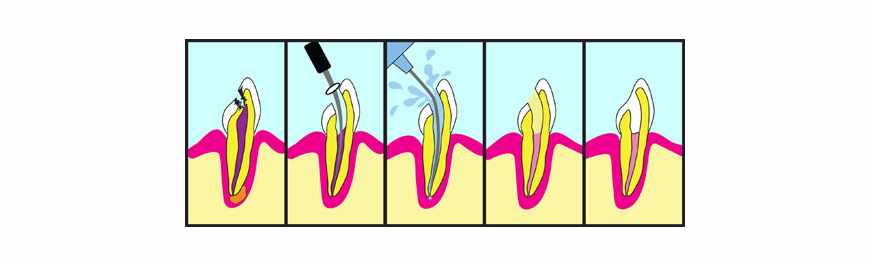
Stages of endodontic treatment:
- necrosis and nerve infection from caries,
- creation of an access well and cleaning-sterilization of root canals,
- blockage of root canals with gutta-percha and
- final tooth restoration with filling or crown.
Due to the sterilization that the dentist tries to achieve during endodontic treatment, a special insulator is placed around the tooth to prevent saliva from entering the area
Also, it is understandable that the more roots the tooth has and the greater the bends they have, the more difficult the treatment will be.
Hours
- Mon-Sat: 10:00am-2:00pm
Tue-Thu: 17:00pm-20:30pm
Contact
-
(+30) 698 798 53 75
