
Hours
- Mon-Sat: 10:00am-2:00pm
Tue-Thu: 17:00pm-20:30pm
Contact
-
(+30) 698 798 53 75
Contact Form
Simple and Surgical Wisdom Tooth Extraction
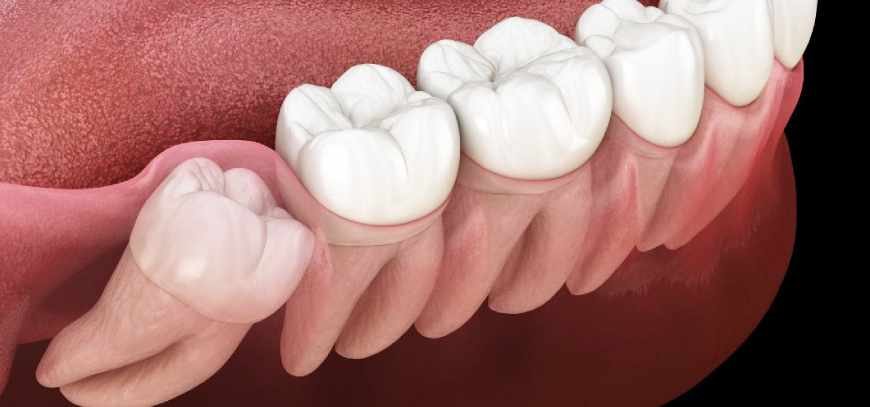
Tooth extraction is the removal of one or more teeth from the dental barrier.
Usually, tooth extraction is done in teeth damaged by caries, in periodontal disease, in tooth trauma – especially when there is also a toothache – in improper tooth development, e.g. impacted wisdom teeth) and in orthodontics ( often premolars) to make room for the rest of the teeth to straighten. Tooth extraction is usually a relatively simple procedure and is done using local anesthetics. Some teeth are more difficult to remove for a number of reasons, including the position of the tooth and the shape of the tooth roots.
The wisdom teeth or third molars, according to medical terminology, are the last teeth of the permanent dentition that develop and appear in the mouth towards the end of adolescence, where the period of adulthood begins and the person matures and acquires wisdom. These teeth often create problems, either with the pain they cause during their eruption, or from the complications they can create in cases where they are in an incorrect, ectopic eruption position.
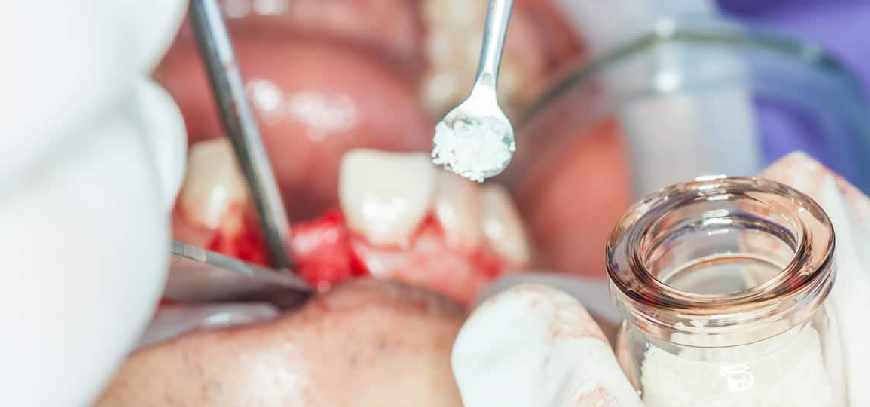
If a tooth is in the bone (eg impacted or partially impacted wisdom teeth) extraction may need to be done surgically, which involves cutting and removing the bone that holds the tooth. After the tooth is removed, stitches are placed.
Export wisdom tooth
The wisdom tooth is the tooth that, from a young age, is accompanied by several problems. It is not an issue that concerns only teenagers, as it is not uncommon for someone to suffer from wisdom teeth even in old age.
If you realize that a wisdom tooth is causing you problems, you should consult a specialist in time to deal with the symptoms and discuss with him the treatment options you have.
Why does a wisdom tooth behave differently from other teeth?
The wisdom tooth or molar or third molar is the last tooth of the permanent dentition and normally erupts between the ages of 17-23.
Sometimes, however, due to a lack of space, the tooth does not erupt at all and remains locked inside the jaw – the so-called locked wisdom tooth. In other cases, a part of the tooth emerges while the rest of the tooth remains hidden under the gums, the so-called semi-occluded wisdom tooth.
The wisdom teeth or third molars, according to medical terminology, are the last teeth of the permanent dentition that develop and appear in the mouth towards the end of adolescence, where the period of adulthood begins and the person matures and acquires wisdom. These teeth often create problems, either with the pain they cause during their eruption, or from the complications they can create in cases where they are in an incorrect, ectopic eruption position.
Wisdom tooth and position in the jaw
The fact that there is a wisdom tooth in the mouth does not necessarily mean that this tooth should be extracted.
Cases are not rare, where there is enough space in the jaw and the wisdom tooth takes the correct position like any other normal tooth (1).
But when there is a lack of space, then a wisdom tooth can become lodged in the jaw and become immobilized under the gums. Such an embedded wisdom tooth may have a definite call (2), or be horizontal and perpendicular to the root of the last tooth (3).
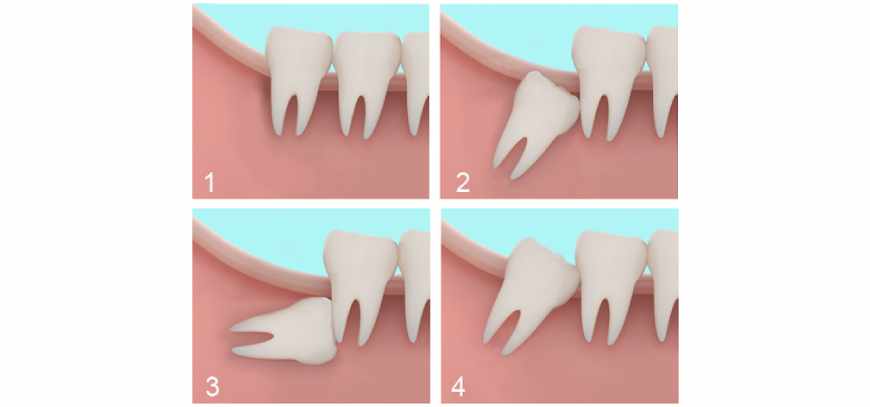
However, there are also cases where, despite the lack of space, a wise man manages to be placed more superficially. Thus a part of the tooth penetrates the gums and is visible in the oral cavity, while the greater part of the tooth remains enclosed in the jaw – these are the so-called semi-occluded wisdom teeth (4).
Why does a wisdom tooth cause pain?
As the wisdom tooth is in a very difficult part of the mouth, it is almost impossible to brush it properly and bacteria can easily grow. Especially when a wisdom tooth is semi-enclosed, it communicates with the oral environment, infections develop (peristephanitis) which are manifested by pain, swelling, bad breath and difficulty in swallowing or limitation in opening the mouth.
What problems does an incarcerated wisdom tooth create?
The most common problem with an impacted wisdom tooth is that it causes inflammation. In some cases, due to the close contact with the banker that is right in front of him, a periodontal pocket and permanent destruction of the bone that supports the second molar is caused. This results in the frequent occurrence of periodontal inflammation which gradually weakens the support of the adjacent tooth.
A semi-occluded wisdom tooth usually presents more problems, as in addition to frequent inflammations (1), it tends to push the rest of the teeth – due to its inclination – causing crowding and irregularity in the position of all the other teeth in the jaw (2).
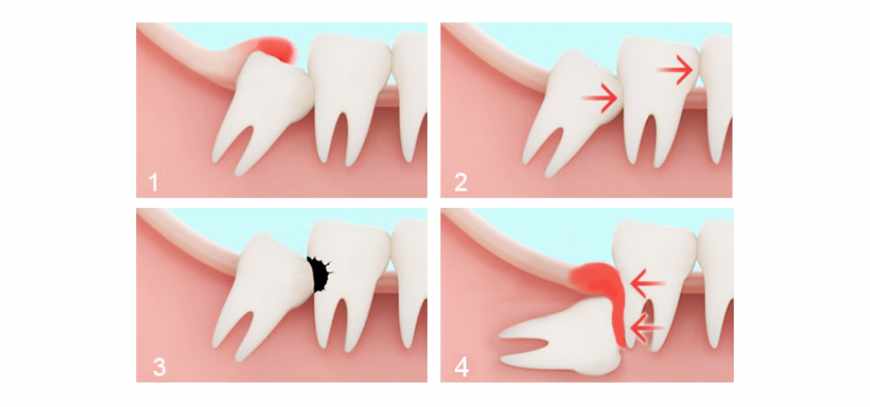
As this area is in direct contact with the oral cavity and it is almost impossible to perform effective oral hygiene, caries is created not only in the wisdom tooth (which is not functionally necessary for us), but also in the permanent second molar – banker (3). In still other cases, a deep periodontal pocket can be created, which, in addition to frequent inflammations, causes loss of the bone and the support of the adjacent tooth.
Thus, if the problematic wisdom tooth is not extracted in time, we will reach the point of losing another valuable tooth – such as the second molar – as a result of which the normal functioning of the mouth will be altered.
When is a wisdom tooth extracted?
It is important to have wisdom teeth extracted at a young age. This has the advantage that the roots of the wisdom tooth will not have fully developed, which means an easier, painless operation. The most important benefit of wisdom tooth extraction at a young age is that we prevent permanent damage to the adjacent teeth and tissues.
Wisdom tooth extraction is an operation that most people will eventually need. It is done with local anesthesia and within a few days the symptoms subside and we can return to normal life rhythms.
Extraction of wisdomite and a-PRF
A-PRF™ and modern bio-technology comes to give us solutions, especially in complex and advanced cases of an indented wisdom tooth.
After the surgical removal of a wisdom tooth (1), an empty space (2) is created where the root was. Natural healing results in the gap being closed with bone and connective tissue.
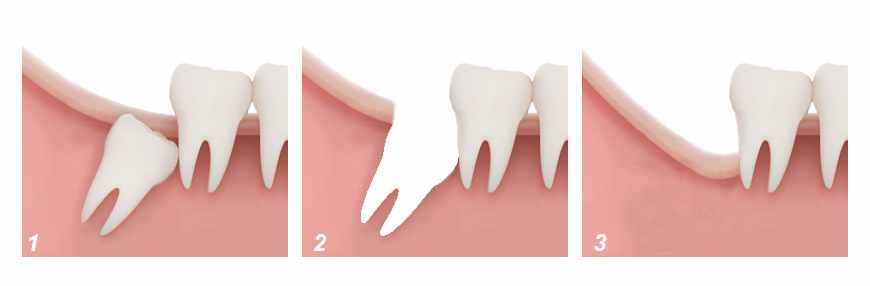
Especially in difficult cases, the shrinkage of the bone and gums is so intense that it creates damage to the bone support and the gums of the adjacent tooth (3).
With the a-PRF™ method, we place at the site of the operation regenerative clots and membranes (2) which release growth factors, as a result of which we minimize bone loss (3).
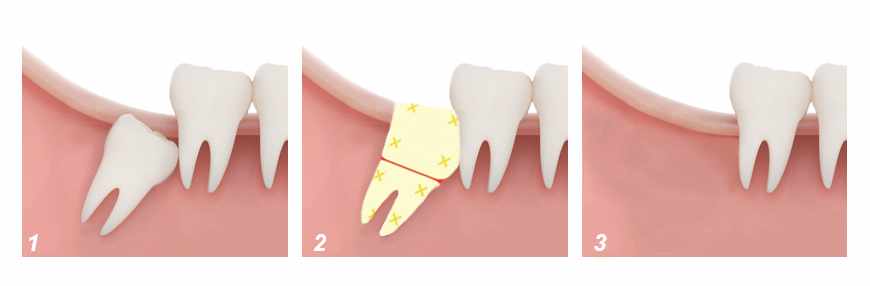
Thanks to the growth factors and the a-PRF™ method, we strengthen the body’s regenerative capacity, reducing gum recession, especially in difficult cases, and most importantly, we protect the remaining permanent teeth by ensuring a perfect bone support and healthy gums.
Hours
- Mon-Sat: 10:00am-2:00pm
Tue-Thu: 17:00pm-20:30pm
Contact
-
(+30) 698 798 53 75
